Saturday, July 23, 2011

The Celtic Tiger

Upon arrival to Ireland the phrase ‘Celtic Tiger’ was mentioned numerous times. It became clear early on that this time had a huge impact on not only the layout of the city but on the people of Ireland. After covering the Celtic Tiger in Seamus’ class I have learned of both and the reasons that it has since fallen. The Celtic Tiger was the most important economic boom that the country of Ireland has ever seen. Known as ‘The Boom’ or the ‘Economic Miracle’, the Celtic Tiger has the world in awe of its growth and economic success. In the years 1994 to 2000, this small country grew in astronomical proportions. The year 1994 marked the unofficial birth date of the Celtic Tiger; its growth advanced at a historically unprecedented average of 6.9 per cent annually. This development is easily attributed to two main causes today, an increase in the amount of people working and an increase in working productivity. During this period not only did the workforce nearly double, but the growth of output per worker grew 3-4% greater each year. The answer to how such growth took place in such a short amount of time is hidden within both internal and external influences, which allowed for the previously stated causes to emerge.
A view of the Docklands
Docklands Development Authority
Understanding that the Celtic Tiger was not nearly as systematic as hoped, it is evident that for Ireland, the country fell into a great economic boom partly consciously and partly by luck. This mixture lead to a great deal of change for the country and unfortunately has been a learning experience in disguise as yet another recession has hit. As a study abroad student, it is interesting to note the extreme growth that the Celtic Tiger has left behind, particularly in the case of the Docklands. On our tour of the Docklands we learned of the major plans undertaken by the Dockland’s Authority. Although many of the projects were completed, there were various towers including the U2 tower, which were never started--- due to the lack of funding. Our tour group was literally the last group to pass through the Docklands Authority building. It was extremely daunting to hear the amount of stress and sadness that was in the voice of one of the members fully invested in the project as she relayed her story. This authority, comprised of well-established individuals, worked for most of their careers on what is unfortunately considered to be a failure. In my personal opinion the Docklands promise huge potential. Once Ireland comes out of its recession the Docklands will surely attract the public they once hoped to. The Docklands is just one of the many places visited where traces of an economic boom are extremely apparent. 


Irish Politics: Visit to the Leinster House

Politics in Ireland vary from politics in the states. It is more likely for Irish politicians to single handedly reach out to specific sectors of the country and physically gaining supporters by knocking door to door. This seems unusual to the average voter in the states. It is more likely for Americans to meet local politicians rather then the big names. The political system in general is very interesting and appealing to me, however there are various aspects that I have yet to uncover.
While visiting the Leinster House a picture was painted, the Civil war lead to the creation of Fianna Fail and Fine Gael. These two political parties are evidence of what remains of the conflict today. These parties have had both tremendous success and downfalls throughout the years following the Civil War. Present day, after the 2011 general election, Fine Gael is Ireland’s largest party. The party represents and has identified itself with the values of social democracy advocating a liberal agenda. Thus it is seen as a centre-right party.  Its supporters are large farmers and businesses. Today Fine Gael is a member of the Christian Democratic European People’s Party. It is viewed as a more conservative party, adopting a less nationalist position on Northern Ireland.
Eamon de Valera founded Fianna Fail in 1926. This party initially began as a radical anti-treaty party with such supporters as small farmers and workers. Today the party is associated with a more republican outlook, but considers itself neither Left Wing nor Right Wing. Fianna Fail is the political party who was in control during the years of the Celtic Tiger, and responsible for the spending habits, which are were seen reminiscent of that of a more left wing party. Due to the economic crash, the Fianna Fail have fallen out of favor and instead replaced by the Fine Gael.
It is not just these two political parties that are responsible for the past history of Ireland’s politics, a third party exists, the Labour Party. This party is considered to be the centre-left and social democratic side of the Republic’s politics. It is the second largest party and has partaken in coalition governments with both Fianna Fail and Fine Gael in past years.
These three parties, direct descendents of the division of the Civil War’s opposing sides, continue to govern Ireland today. It is important to note the history of Ireland and its growth via these politic parties. Because these events are still new, happening within the last 100 years, lingering ties to each side are apparent when looking at both the Fianna Fail and Fine Gael parties.
Politics in Ireland, as I have learned are extremely competitive. It baffles me that only about 15% of the seats held are by women, considering there is an even split in the population ratio of male verses female. We have covered the issue in class and have addressed it in writing, however the topic is still open-ended for me. Today the president, Mary McAleese is the face of governmental politics for the country while the Taoiseach is currently and historically always has been male. It was made clear to us throughout our studies that the president, unlike the American President has much less power. It is largely a ceremonial position. This is all very interesting and new to me, I hope for the future of Irish politics however, that more females move into power to more evenly represent the public

Wednesday, July 20, 2011

History Around Dublin

Inside a cell at Kilmainham Gaol

Learning about Irish History has proved time and time again to be of utmost importance to my foundation of understanding the Irish culture.  Having a solid background in Irish history has allowed me to appreciate my time here even more. I have learned about the countries hardships as well as its success, enriching my relation to the society I have grown to know and love. Being in a foreign place for such a limited amount of time has inspired me to take in as much as I can before I disembark. Due to this I have visited a wide assortment of historical landmarks. Of the places visited my favorite has been my trip to the Kilmainham Gaol.

The jail holds an immense amount of history within its protected walls. With thousands of prisoners once held within its grounds due to the potato famine, various political movements, and crimes; my visit was incredible. I was able to walk into a cell and around the premise, the same as Constance Markievicz, who was elected to Westminster parliament in 1918, once did. The jail also plays an important role in the events leading to the War for Independence. As does another important building located locally as well, the General Post Office. Along with the jail, the GPO is one of the most important buildings in Irish history. Its significance lies in its involvement in the Easter Rising--- an event which inedibility lead to the beginning of Irelands fight for Independence. While visiting today, you can still see the bullet holes that mark the buildings front columns.
A cell kept in original condition
The Post Office proves to be truly iconic in the involvement of the Easter Rising. This historical event was a result of an extremist attempted to overthrow British Rule. Visiting the museum located directly inside with Roisin was highly helpful in piecing together these events. Although Britain was prepared to grant Ireland Home Rule, a group of nationalists plotted to demand a free Republic of Ireland. Although the Easter Rising was not necessarily successful, it sparked the beginning of the War of Independence. After this rising, the British took into custody the 14 men responsible for the event. Of which were then held in Kilmainham Gaol, and executed one by one within its walls.
Because of Britain’s unjust retaliation against the leaders, the Easter Rising gained the support of the Irish people. Thus snowballing into war. After a very involved series of events, the Irish War for Independence ended in a standstill in July of 1921. Britain agreed to a truce, as it was loosing popularity with its own people. Although this treaty marked Britain’s recognition of Ireland, it did not recognize the Irish Republic as the Irish had intended. Due to this fact, the treaty caused continued angst amongst the Irish people. It was believed by some that the lives lost during the War of Independence were lost fighting for the Irish Republic, not a Free State. This became the dividing factor within the country itself--- because the treaty established Ireland as the Irish Free State, Britain was still in the picture. The treaty also gave Northern Ireland an option to opt out and remain a part of the Britain, which it did. The official Anglo-Irish Treaty was signed in London on December 6th, 1921.
General Post Office
Although the country did not receive proper recognition for its efforts to control all of its counties, the Irish people were relieved the fighting had stopped. Despite the favored support by the pro-treaty public, the Anglo-Irish Treaty divided the nation into two opposing sides. It was the pro-treaty side who believed that the treaty was not “ultimate freedom… but the freedom to achieve” (Michael Collins). On the other hand, the anti-treaty opposer’s believed the treaty gave “away Irish Independence” and “acknowledged the head of the British Empire as direct monarch of Ireland” (Eamon de Valera). At this point in history, the Irish members of the IRA and political figures part of the Dáil, who had been fighting on the same side, divided and became enemies essentially overnight.
For me to have the opportunity to not only learn about the history of this nation, but to visit the actual places that most of these events occurred is so incredible. There is an immense amount to be learned and putting a ‘face to the name’ of sorts makes all the difference for a foreigner. Although I am one hundred percent an outsider looking in, I feel as though I have a huge tie to the country given my understanding and appreciation of its history. 

Monday, July 18, 2011

Lago Maggiore


          Over the weekend I went to the most amazing place.  Italy is blessed with a series of lakes, some of which share a border with Switzerland.  With my program, we all traveled to lake Maggiore.  It is right next to lake Como, where George Clooney famously owns a house.  Lake Maggiore is just like lake Como except filled with less American tourists.  The lake sits in a valley so that everywhere surrounding the water is mountainous and beautiful.  Our field trip was to Stresa which is one of the towns along the lake.  From Stresa, we took a ferry for a few minutes across the lake to get to one of the most amazingly beautiful places I have ever seen.  Amidst the lake is aptly named Isola Bella, or “beautiful island.”  ‘Beautiful’ isn’t even a strong enough word to describe this site.


This is the view pulling up to the island
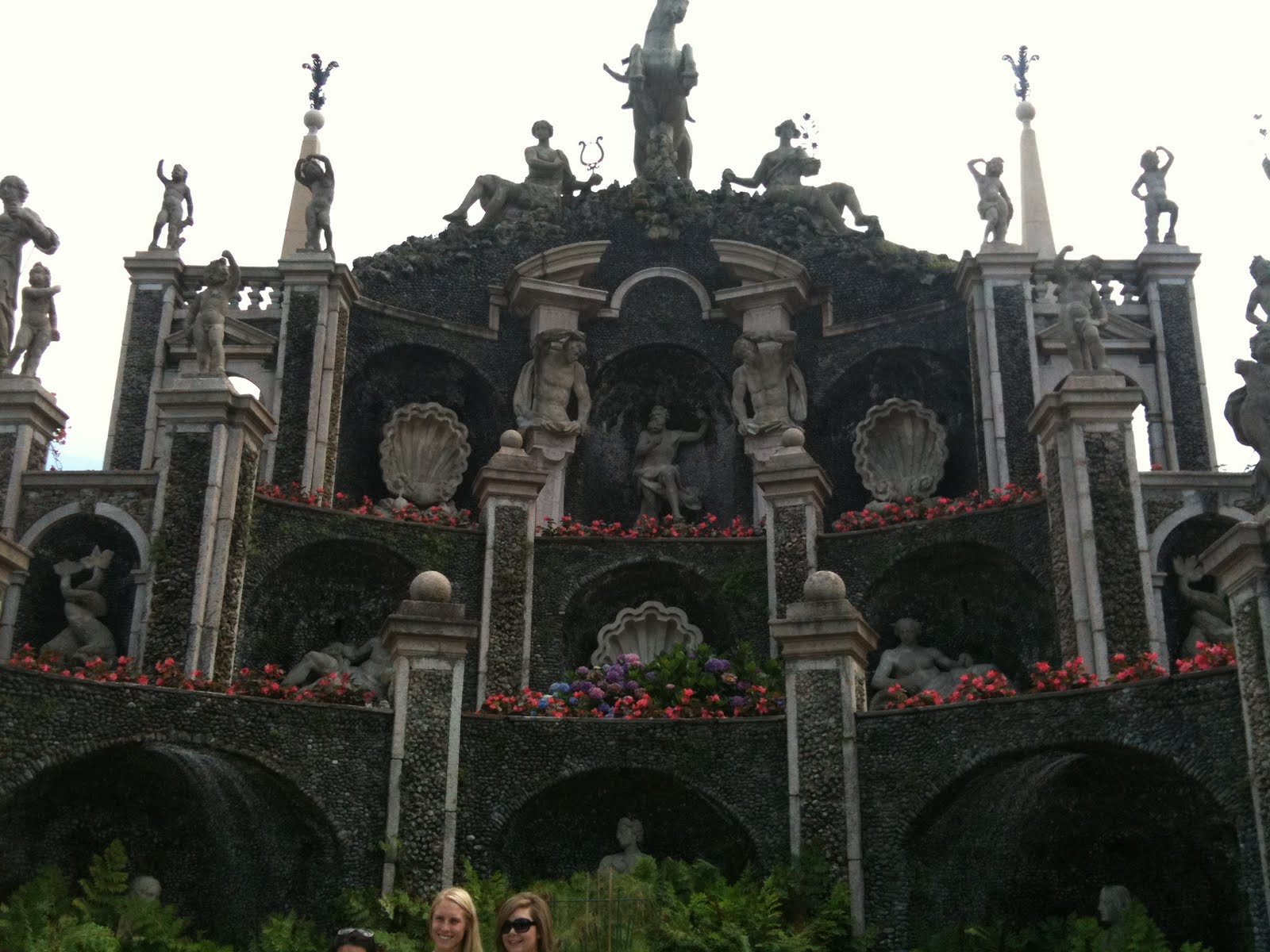
            Upon pulling up by boat, you are greeted by a small island emanating greenery.  On the island is a palace with a garden.  From the boat you receive a view of the garden, and it looks otherworldly.  Ivy covers tall structures and statues are carefully placed at all heights of the almost three-story high garden.  It looks like Atlantis, or something out of a dream.  At a closer look you can see a huge array of colorful flowers.  From the time the ferry pulled up, until after the ferry left the island, my jaw was on the ground.  There are few times I have ever been in awe, but this was definitely one of them.

Here I am with the three friends on the ferry!
            Our group of fifty took a tour of the palace on the island.  The interior was classically baroque, and was filled with pastel colors and ornate décor.  It was amazing and so inspiring.  After seeing room after room of pastel blues, and pinks, each adorned with morano glass chandeliers, we came to a long hallway with a series of seven extremely ornate tapestries.  Woven into these tapestries were silk and gold threads.  Each tapestry took around ten years to make.  After the hallway was a large gate with an entrance to the garden. 
            The garden was just as unbelievable as I expected it to be from the exterior view.  There were stairs laden with ivy and plants that lead up to lush open space lined with purple, blue and pink flowers.  Then up a few more stairs was another layer of the garden; this one had a huge sculpture with different statues that reminded me of a sand castle.  There were also white peacocks in the garden that just walked around and would let you get really close to them.  The whole tour, my jaw was open because I couldn’t believe what I was seeing.

This is inside the palace.  The room was so tall I couldn't fit it all in the picture!


Here are some of the sculptures that you can climb stairs up to and walk around

This is a view of the lake from the garden 

This is just some of the beautiful garden

White peacock!

            After the garden our group got back on the ferry to Stresa where the rest of the group came back to Torino, but three friends and I decided we wanted to spend the weekend on the lake.  We stayed in a hotel in the town next to Stresa called Verbania.  Verbania was absolutely beautiful!  We were right on the lake and the town was even less touristy than Stresa.  On Saturday we took the most amazing bike ride and stumbled upon an open market.  The views, like the one below were nothing short of incredible.


Mi manca a tutti!  [I miss you all!]

Ciao!


Sunday, July 17, 2011

Trip to Northern Ireland


There is an immense amount of unrest that still lingers in Belfast, a Northern city in Ireland. Visiting this part of the country may seem unsafe to some, but thankfully we were well kept after. The FIE program has given its study abroad students an incredible opportunity, one that many visitors simply never see.
The Peace Wall- Belfast, Northern Ireland

The most incredible part of the trip was visiting the peace wall located in the heart of the conflict. Representing the division of a highly controversial religious disagreement, the peace wall remains a symbol of unity. It was my initial reaction that the wall marks the start of a new united country ruled to this day by Great Britain. It was brought to my attention that although the wall offers a sign of peace, it also represents the extreme division between the two opposing religious groups, Catholic and Protestant.  The wall is a literal barrier that separates the two groups. However, while visiting the wall, onlookers will find how powerful the use of words can truly be in uniting not only a society but bringing together a variety of people from various backgrounds. Its presence is most certainly appreciated by visitors and quietly screams the cries of support of millions from around the world. The tradition of signing the wall was passed onto us as students connecting the stories and history of the country that we have called home for the past five weeks.
While in the North, there was an abundance of murals painted to commemorate the various events of the struggle. One of my personal favorites is of a priest waving his white handkerchief to single a ceasefire on Bloody Sunday. The amount of emotion that is evoked while looking at these specific scenes made me appreciate the sense of peace these people now know.


Mural depicting a scene from Bloody Sunday- Derry, Northern Ireland

Lovely Places to Go


Amazing shops and eateries are to be found throughout Dublin. As you can imagine I have only nearly begun to uncover these lovely places. My favorites so far includes a café called The Lime Tree Café, located on the North Side of the Liffy, by Kilmainham Gaol--- which is a must see all on its own. The café has such a warm house feel, serving a variety of sandwiches, soups, and freshly brewed coffee and teas. The service was wonderful and all the ladies working spoke with such delight when welcoming you.
Om Diva, George's Street Arcade
The South side has quite a large selection of shopping options. Whether or not you fancy more of the mainstream well-trafficked shops such as River Island, BT2, Topshop, and Dunnes… or rather love to meander through small boutiques such as Carousel, Costume, and Smock… or sift through awesome second hand shops such as Oxfam and Harlequin, the South side is the place to go! So far Om Diva has been one of my personal favorites. Located right outside of George’s Street Arcade, this store offers the best of all words. On the bottom level you will find consignment items, all second hand finds needing an even better home the second time around! The main level offers cute reasonably priced less known brands, offering both accessories and clothing on uniquely beaded hangers. Upstairs, I could hang out for hours upstairs, the walls were decorated with original sketches and photographs. This is the home to the designer pieces, each more special then the last! You can find intricate headwear as well is asymmetrical designs and homemade jewelry. Needless to say I have gone back multiple times!
Riverdance was just one of the many highlights of my trip here in Dublin! The Gaiety Theatre is beautiful, I felt at home there! As a dancer, I was so excited to experience the show and note the differences and similarities of the Irish production in relation to my own experience. Although the show was not exactly what I had anticipated, I enjoyed it non-the less. My hesitation came from the differences in production from that of Broadway shows. To my surprise, there were an immense amount of differences. The lighting and sound were definitely to note, as well as the simplicity of transitions. The dancing was impressive and the dancers percussion was spot on! But there was a lack of professionalism that was apparent, for anyone who hasn’t already, I would say that you need to go see a show on Broadway!!  Overall it was an amazing experience, and something I wouldn’t have left the country without seeing.


Inside Om Diva


Friday, July 15, 2011

The Irish Language, Visiting the Abbey

The Irish language is one that the Irish tend to feel one of two ways about… there are those that are extremely passionate about preserving this Celtic language and those that are far from enthralled to learn the language in school. After talking with some locals, the Irish language taught in school is very basic, providing students with a very limited array of talking points. On the other hand---there has been, from what I can tell, a recent trend for enthusiasts to revive the use of the ancient language.
Language is a huge defining factor in terms of ones nationality. It is a regional aspect that ties people not only to one another but also to their family lineage. Ireland is the home to many influential writers; four alone have been recognized and given the Nobel Peace Price for their work. Of these four writers is William Butler Yeats.
Yeats himself was an idealist. Throughout his work, he acknowledged the fact that Ireland was a separate entity, unique in its rural simplicity. His work based off a fanaticized land that he dreamt about while away in London. Due to his relocation, Yeats formed a strong sense of nationalism towards his home country as he remembered it. Yeats wrote about this pride in the rolling hills and his rural life so much so, that this was often the only part of Irish society portrayed. Every piece of Yeats’ work included this idealism and played to his thoughts on nationalism, of which spoke volumes to his concept of conserving Irish heritage. 
In addition to diving into the work of Yeats, we were fortunate enough to visit the Abbey Theater. This historical monument has offered great works of literature performed on its stage since 1904. The play Translations was exceptional. One critic was quoted, “More than thirty years since it was first produced, Translations is now regarded as a modern masterpiece. Subtle and resonant, it’s a political drama, a historical tale, a funny and clever play about language and a tender love story”. Brian Friel’s, Translations was an amazing introduction into the series of events that almost forced the Celtic language out of use. The Anglicization of words, started with the renaming of the Irish landscape. Taking place solely around the structure of a hedge school, the audience is told the story of the importance of language for Ireland’s people.