Showing posts with label Drexel. Show all posts

Wednesday, August 28, 2013

The Charles Bridge


The time has finally come- this week marks my last few days in Prague! Our program officially ended about three weeks ago, but those weeks and even the past two months have absolutely flown by. I'm exceptionally grateful to have had to opportunity to travel beyond the borders of the Czech Republic to Rome, Budapest, Berlin, and Vienna just this past weekend. I've hosted several friends and been able to play tour guide, testing the knowledge I've obtained over my classes this summer. I think my architecture instructor would be proud of the way I can rattle off hallmarks of the Art Nouveau style as exhibited in Prague architecture. That being said, I'm ready to move on to my next adventure, one that will take me to Amsterdam, Paris, and London! Before I leave I'll have three days to show my friend, who I will be travelling with, highlights of the city, and our first stop will likely be the Charles Bridge.

The Charles Bridge is one of Prague's most iconic structures. The bridge was initiated by King Charles IV to replace a previous bridge that was destroyed when the Vltava River flooded. Crossing the bridge will take you from just outside of Old Town over the river to Mala Strana, or Lesser Town. The bridge was originally designed in the Gothic style, elements of which can be seen in the three towers that rise up at either end. The 30 statues that now decorate the sides of the bridge are all replicas that have replaced the damaged originals.


The bridge is a magnet for tourists and therefore a magnet for vendors. The artists and street performers you'll find there all have a document on display that serves as permits, and the Charles Bridge Artists Association is a "civic non-profit organization" that works to "preserve Charles Bridge's traditional atmosphere of an open-air gallery."


The bridge is crowded most hours of the day, and even if you visit the bridge in the early hours of the morning you'll find a choice few wandering across the stones. My favorite time to go, mostly for the sake of photographs, is just before the sunset. The crowds have usually dwindled and the light is stunning.

I won't miss the hoards of tourists who wander into my frames, bump into my shoulder, or stop abruptly to take pose-y vacation photos, but maybe once I'm gone those aspects will fall to wayside and I'll miss the historic atmosphere and old-world charm.

Friday, August 23, 2013

Letná Park


One of our favorite places in Prague to visit as a group was Letná Park at sunset, where a lot of the younger locals would hang out. The spectacular views one can witness from the park is certainly no secret, but I have found it to be devoid of the tourist raucous one would encounter at a place like Petřín Tower. Letná Park (in Czech Letenské sady) is situated on an embankment high above the Vltava River. It was on this concrete pedestal that a monumental statue to Joseph Stalin was erected in 1955 and then destroyed in 1962. In its place sits a giant functioning metronome, and during the day one can watch it go back and forth from as far away as Old Town Square. The metronome is supposed to symbolize positive progress in the Czech Republic after the fall of communism and is representative of a bright future. Now the park is a popular place for skateboarders, break-dancers, and it is even used as a concert venue.


 Last week I was lucky enough to find the metronome working at night! There was a giant tent set up not too far away in the park, so it's likely the metronome was turned on in for an event.


From the edge of the plinth you can look straight down Parizka (Paris Street) and see Old Town Square...


...not to mention Charles Bridge and Petřín Hill way in the back! The view is absolutely unparalleled.

Monday, August 19, 2013

In Berlin!


Last weekend I had a difficult decision to make: Florence or Berlin? I had originally been invited to visit Florence with some students who planned to make their way across Italy, France, and end in Barcelona. I've aspired to see Florence for years, but when a different group of friends invited me to go with them to Berlin, I had to reconsider my options. I had already spent a wonderful weekend in Rome, and the likelihood that I would be able to come back to Germany any time soon is rather slim. So one 5-hour bus ride later, I was on my way to Berlin!

In front of the Brandenburg Gate in Pariser Platz
I met my friends at the hostel on Sunday, but our tourist itinerary wasn't set into motion until early Monday. We downloaded a self-guided walking tour of Mitte, the historical district, from the Berlin TripAdvisor app which I would absolutely recommend! In one afternoon we saw Pariser Platz, the Reichstag parliament building, the Holocaust memorial, Treptower Park, Tiergarten, and Berliner Dom.


Under the architrave of the Reichstag is enscribed "Dem Deustchen Volke," which means "To the German people." We also registered to visit the Reichstag Dome, a large glass done that gives one a 360-degree view of central Berlin, but I registered for the wrong day!


The Holocaust Memorial consists of over 2,700 concrete slabs on a sloping ground. Our guide noted that it appropriately gave "an uneasy sense of order." The ground slopes in such a way that towards the center of the monument, stelae that once were short enough to sit on tower over you and encapsulate you in their massive gray shadows.


On Tuesday we spent a relaxing morning exploring our neighborhood. Our hostel was in the middle of Kreuzberg-Fredrichschain, which is packed with cool restaurants, quaint bars, and a handful of edgy, independently owned shops. Just across the river was the East Side Gallery where artists had been commissioned to decorate the remains of the Berlin Wall. 


Our second day of fervent tourism was capped off with a visit to Checkpoint Charlie and the Berlin Wall Museum. Checkpoint Charlie, which refers to the phonetic alphabet used by the U.S. military, was the most trafficked point between East and West Berlin while the wall was still standing. The Berlin Wall museum had a strange and rather unofficial set-up, but my friend pointed out a sign that noted the museum was opened shortly after the wall was erected as a monument to human rights. The museum holds tons of newspaper articles highlighting the series of political events that led to the construction of the wall, stories of people who escaped both successfully, and those who were persecuted when they tried to escape. The resourcefulness of certain individuals was both amusing and frightening, and some people went to great measures to escape from their walled-in capital. One of my favorite contraptions was a hot air balloon that two families flew over the wall in the middle of the night.


Berlin, you were both beautiful and intriguing, and I am counting the days until I get to see you again!

Wednesday, August 14, 2013

Buda + Pest


While I won't be venturing back to the States until mid-September, most of the other friends I've made on this program will have left to go home as soon by the time this post goes up. Taking advantage of Prague's central location during our last weekend on the program, several groups of us took the opportunity to travel to Budapest, Hungary!

As silly as it sounds, three different groups of students traveled separately and each with a different itinerary to the same city...on the same weekend. Three students flew out of Prague shortly after our classes ended on Friday and spent the weekend at a giant music festival held in on of Budapest's thermal bath complexes. A second group rented a couple of cars and drove across several nation's borders. Finally, favoring the least expensive option, a friend and myself booked two tickets for a night train that left Prague at midnight on Friday. When we woke up on Saturday morning, we were in Budapest!


The most advantageous part of taking the night train was that we awoke well-rested, ready to explore a new city, and we didn't have to pay for an extra night in a hostel. Our accommodations were in a rather central location just off of Andrassy Avenue, so after dropping of our bags we walked down to Heroes Square and the art museum (which is featured in the first picture of this post!). We escaped the overwhelming heat that plagued Budapest that weekend in the art museum, and then we mustered up the courage to explore City Park. The park is home to Vajdahunyad Castle, a zoo, a transportation museum, and the Széchenyi Thermal Baths.


Later that night we explored the nightlight on Margaret Island, which is located in the middle of the Danube River. The river used to divide what is now Budapest into two separate cities, Buda and Pest, until they were united by the Chain Bridge. 


The next day's weather was just as sweltering, so we ended up abandoning our original plans to explore Buda Castle and parliament. Instead we strolled through the shopping district, sat in the shade in parks along the river, and walked through one of the many markets that were being held in the city on that weekend. The highlight of our trip? The Kürtőskalác! Known as a Trdelník in the Czech Republic, this desert of Hungarian origin is is a thin pastry whose dough is wrapped around a cylinder, baked, and then sprinkled with sugar or cinnamon. 

Two days was not nearly enough time to explore Budapest or to eat as many kürtőskalác as I would have liked, but this is just an excuse to pay the city another visit! Next up for me? Relocating to my new apartment in Prague, then another excursion to Berlin!

Wednesday, August 7, 2013

St. Nicholas Church

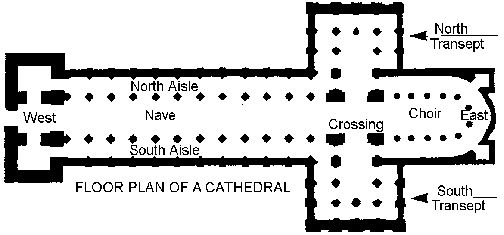
Prague is home to 3 different churches of St. Nicholas, the largest of which is found in Lesser Town Square (Malostranské náměstí). During our second week of classes, we had the privilege of having our architecture lecture conducted in the nave of this very church!

It is important to note that while St. Nicholas in Mala Strana is a cathedral, its counterpart in Old Town Square is merely a church. The differentiation between these two places of worship lies in their most basic structure. A cathedral plan has very specific characteristics, including a central nave with flanking aisles, a transept, crossing, and choir. 


Entrance to the church is free, but in order to walk through the aisles that surround the nave you have to purchase a ticket. When we registered for our classes we payed a fee that was meant to cover the costs for most of our class excursions, so when we arrived our tickets had already been purchased and set aside for us. I, along with most of the other students in the architecture course, agreed that the trips we took during our class time were the highlight of our study abroad classroom experience. Carol, our instructor, has been teaching this summer course for 13 years and even studied at Charles University in Prague when she was a graduate student. Instead of spending most sessions in the classroom building, we had the opportunity to walk around the city and visit monuments that were both popular tourist attractions and culturally significant.

Our tickets granted us access to the upper gallery where one gets an incomparable view of the ornate interior of Prague's most substantial baroque building. The baroque period was characterized by an almost chaotic utilization of ornamentation with gilded ceiling, dynamic statuary and trompe l'oeil ceiling paintings. After exploring the church we sat in the pews and sketched the interior for 10 minutes for an assignment that was to capture elements of the building that we felt best characterized its baroque style.


This trip ended up being especially beneficial for my other class, a special topics photography course where I took my favorite shot of the term. Check out our classroom's blog that we've kept updated with our weekly assignments over at People & Places: Prague.
Wednesday, July 31, 2013

When in Trastavere...


Anyone who knows me can vouch that I have been dreaming of traveling to Italy for years. This past weekend, while most of the American students in Prague took a train ride to Vienna, Sam and I made a tiny detour...to Rome!

Our apartment ended up being located in what was touted as the perfect neighborhood, Trastavere. Trastavere is on the southwest side of the Tiber River, below Vatican City, and it consists of several universities and an eclectic mix of restaurants, bars, shops, churches, cafes, and local Roman residents.

On our first night we found an aperitif bar that was just around the corner. At L'aperitivo, one pays around 8 euros for an aperitif, or an alcoholic drink that is normally consumed before one's meal. Then, with the show of your receipt, you have access to a delicious and variant antipasto buffet. Freni e Frizioni was apparently appeared to be the most favored bar in the neighborhood, with groups of younger local patrons and tourists alike spilling out of the small locale and into the square along the main street.

Despite being intrigued by the nightlife that was peaking all around us, we collapsed in our beds soon after dinner, weary from our day of traveling, and woke up early the next morning when our tourist endeavors ensued!


The Colosseum, the Pantheon, the Trevi Fountain, Piazza Navona, the Sistine Chapel - we saw it all. The fountain is the largest Baroque fountain in Rome, and the Pantheon is extremely well preserved and has been in used consistently since its construction. Sam was an awesome tour guide and, having been to Rome before, she managed to map out some pretty efficient routes. Over the course of just less than 3 full days we were able to witness a striking collection of some of the most significant remaining architectural and historical structures that are still standing today. Watching slides of the Pantheon flash before your eyes during an Architectecture & Society lecture more than pales in comparison to seeing these structures in person.

What struck me the most about Rome is how condensed the city way. The historic center especially has several monuments packed into such a small area, with modern building having sprung up around every corner. I can only imagine living and working in a city where you pass the Fontana di Trevi every morning when you ride your moped to work.

And on our way to the airport on Sunday, only minutes before we caught the Metro to Termini Station, we stopped to take in the Spanish Steps at the Piazza di Spagna.

Wednesday, July 10, 2013

The Art of Packing


I have expressed this notion before, but sometimes packing feels like picking a favorite child. My closet is a carefully curated collection, each piece with its strengths and weaknesses which can be effectively employed to help me adapt to various situations, and I often feel reluctant to part with it. In accordance to my rather recent initiative to adopt a "less is more" approach to life in general, I embarked on a mission to compact my most essential articles into a single suitcase.

Before you even start filling your suitcase, the first step is to make a plan! Carry a small notebook with you during the few weeks before your trip and jot down any ideas that come to mind. Gather everything you need and make notes to omit things that might just add extra weight to your luggage. Because I'll be travelling after I'm through with classes, I've decided not to pack things like shampoo that I could easily buy once I arrive at my destination. In terms of clothing, start by laying out the pieces you're certain you want to bring. The easiest way to stretch your limited wardrobe is to make sure that every piece has at least two more items to wear with it.


Start by making a layer in the bottom of your luggage with irregularly shaped items like shoes and cosmetic bags. Everything doesn't have to fit together like puzzle pieces because you'll be filling the gaps with your clothing later.


Next, instead of folding your knits, roll things like tees, scarves and leggings. Rolling compacts the garments more effectively than folding them, and you can also use the rolled items to secure things like shoes. Sometimes I like to roll lightweight woven garments as well, especially because most synthetic fabrications won't crease.


On the top layer, I like to place more wrinkle-prone fabric like cotton and silk. The best way to avoid deep-set creases, especially because a heavy iron is the last thing you'll want to bring along, is to layer shirts and dresses and fold two of them together.

I like to keep more valuable items like my laptop, camera, and passport close by in my carry-on bag. Additionally, because there is always a chance that luggage may be misplaced, I'll be bringing a change of clothes and travel-sized toiletries. Make sure you reference the TSA guidelines for packing liquids before you get to the airport. Another thing to note is that you'll have to remove your shoes when you go through airport security, so your best option in terms of footwear would be flats that can be slipped off easily and worn with no-show socks.

By the time this post goes up (if everything goes as planned) I will already have landed in the Czech Republic! Let's hope my own packing advice serves me well.


Tuesday, July 2, 2013

Crash Course: Prague 101


Hello, and welcome to d&mAbroad! My name is Courtney and I'll be one of several bloggers reporting from the city of Prague this summer as I wrap up my junior year. It's likely you were able to infer that I'm a design & merchandising student at Drexel, but over the course of the summer I'll also be working towards my minor in art history and continuing to build my skills as an amateur photographer. I'll be enrolled in a survey of architecture and design as well as a street photography course, so prepare yourselves for loads of photos. Additionally, I've been granted the wonderful opportunity to develop a project for the study abroad department as part of a scholarship program, so hopefully I'll be able to provide you with updates along the way. 

I've known since my freshman year of college that Prague was the city for me. Since I've been accepted into the program, though, news of my travels have been met with resounding...ambivalence. "Oh! Prague? Where's that?"

(Image credit)
Nestled between Germany, Poland, Slovakia and Austria, Prague is the capital city of the Czech Republic. The history of this city spans a millennium: it once served as the seat of the Holy Roman Empire and Prague Castle is noted as the oldest ancient castle in the world. A coworker once referred to it as "the jewel of Central Europe" with numerous cultural hubs merely a train ride away. While I will be spending an additional month in Prague, I fully plan to take advantage of its central location. I'll be venturing to Vienna, Budapest, Rome, Berlin, Paris, and London before I make my way home to the states. 


Over the past three weeks, those of us enrolled in the program have been attending a "crash course" in Czech language and culture. We've been assigned a series of readings, plays and political manifestos alike, in order to give us a fundamental understanding of the modern Czech. Unfortunately, a solid understanding of the language has not been as easy to grasp. I experienced my first wave of panic during a phone call I made to a foreign airline last week. The woman on the other end answered in Czech and I, upon realizing that I recognized none of what she said, was unable to muster more than a pathetic "Um..." 

That being said, I'm off to spend some quality time with my Lonely Planet phrase book and a Czech audiobook in preparation for my departure next week. Wish me luck!